Apply Public Limited Company Registration in India
Secure Public limited company Registration in India with E-Startup Experts Assistance. Public limited company registration helps in infuse more capital, few risks & better opportunities to grow and expand your business. Contact us now.
Contact us
Highlights
#1. Limited Liability
Liability of shareholder for the losses of the company is limited to their contribution only.
#2. Perpetual Succession
A business of the Company will not affect if there is any change in the ownership of the company.
#3. Listing on Stock Exchange
Public Company can be listed on stock exchange and raise funds by way of public issue.
#4. Transferable Shares
Shares of a public company are freely transferable between its members and non-members.
#5. Disclosure & Transparency
The public company ensures stringent disclosure compliances. Financials of the company is in public domain.
#6. Minimum Directors & Shareholders
Minimum 3 directors, Minimum 7 shareholders required and there is no limit on maximum shareholders of the company.
Why choose public limited company
Upload the Required Documents & Information to our web portal
#1. Unlimited Members
One of the best advantage of public ltd company is that there is no limit on number of members in the company.
#2. Limited Liability
Despite having characteristic of unlimited members the liability of all the directors in Public limited company is limited to the extent of stake they hold in the company.
#3. More Transparency
Working of a public ltd company is more transparent because it separates its management from its ownership.
#4. Property Rights
A Public ltd Company can gain, posses, and enjoy its property in its own name. No shareholder can claim upon the property
Public limited company incorporation process
STEP 1
Upload the Required Documents & Information to our web portal
STEP 2
Choose Package and Pay online with different payments modes available
STEP 3
We will apply for Digital Signature and Director Identification Number of proposed directors
STEP 4
Check for Company’s Name availability, apply for Name Approval.
STEP 5
Prepare MOA, AOA and other necessary incorporation documents.
STEP 6
File incorporation documents & obtain Certificate of Incorporation, PAN &TAN.
Advantages of Public Limited Company Registration in India
#1. Raising funds is easy as Public Limited Company can issue the shares to the public. Thus, expansion and growth is rapid
#2. Death or departure of its shareholders or directors does not dissolve the company. Thus, business continuity is possible.
#3. Better corporate governance and accountability are promoted as Public Limited Companies are subjected to strict regulations and guidelines.
#4. The shares of a Public Limited Company can be easily sold or bought on the stock exchange, offering shareholders greater transferability and liquidity of their investment.
#5. Public Limited Companies can enjoy various tax benefits which are beneficial for both the company and its shareholders.
Annual Compliances for a Public Limited Company
Listed and Unlisted Public Limited Companies have to follow a set of annual compliances in order to function legally. These are as follows:
Annual Compliances for Listed Public Limited Company
| No. | Compliance | Details | Form | Section | Deadline |
|---|---|---|---|---|---|
| 1 | Annual General Meeting | Conduct AGM in compliance with the Companies Act | Form MGT-15 | Section 121(1) of the Companies Act, 2013 | Within 30 days from the date of incorporation |
| 2 | Financial Statements | Prepare and file financial statements, including balance sheet, directors report, cash flow statement, auditors report and consolidated financial statement in XBRL format | Form AOC-4 | Section 137 of the Companies Act read with Rule 12(2) of the Companies (Accounts) Rules, 2014 | Within 30 days of holding the AGM |
| 3 | Annual Return | File information about directors and shareholders with the Registrar of Companies | Form MGT-7 | Section 92 of the Companies Act, 2013 read with Rule 11(1) of the Companies (Management and Administration) Rules 2014 | Within 60 days of the AGM |
| 4 | Financial and Directors Report | Adopt financial and directors reports | Form MGT-14 | Section 173 read along with Secretarial Standards 1 | Within 30 days from the board meeting |
| 5 | Income Tax Returns | File income tax returns with the Tax Department | Form ITR-6 | — | On or before September 30th of the financial year |
| 6 | Secretarial Audit Repor | Submit Secretarial Audit Report along with Board Report if total paid-up capital is equal to or crosses Rs. 50 crore or annual turnover exceeds Rs. 250 crore | Form MR-3 | Section 204 of Companies Act, 2013 read with Rule 9 of The Companies (Appointment and Remuneration Personnel) Rules, 2014 | Before appointment or reappointment of The Secretarial Auditors |
| 7 | SEBI Compliance | Comply with all rules and regulations associated with SEBI, including Listing Regulations of 2015 | — | Listing Regulations of 2015, SEBI | — |
Annual Compliances for Unlisted Public Limited Company
| S.No | Compliance | Particulars of Compliance | Form No. | Section and Rules | Due Dates |
|---|---|---|---|---|---|
| 1 | Board Meeting | Conduct at least four meetings a year and discuss matters related to the appointment or reappointment of auditors or related issues. | N/A | Section 173 of the Companies Act | At least 4 Board meeting in a year. |
| 2 | Appointment of Cost Auditor | Issue a letter of appointment to the Cost Auditor and inform the Central government of its appointment. | Form CRA-2 | Section 148(3) along with Rule 6(2) and Rule 6(3A) of the Companies (Cost Records and Audit) Rules,2014 | Original appointment within 30 days of the Board Meeting or 180 days of the financial year, whichever is earlier. Casual vacancy to be filled within 30 days of Board Meeting. |
| 3 | Return of Deposits (DPT) | File the Return of Deposit before the Registrar of Companies or ROC. | Form DPT-3 | Rule 16 of Companies (Acceptance or Deposit) Rules, 2014 | 30th June of every year. |
| 4 | Appointment of CEO or CFO or CS | Appoint a full-time or casual CEO or CS or CFO and file the necessary forms. | Form MGT- 14 and Form DIR-12 | Section 203 read with Rule 8 and 8A of the Companies (Appointment and Remuneration of Managerial Personnel) Rules, 2014 | Within 30 days of the Annual General Meeting and, in the case of a casual vacancy, within 6 months. |
| 5 | Annual General Meeting | Conduct the Annual General Meeting for the declaration of dividends. | N/A | Section 96 of the Companies Act, 2013 | First Annual General Meeting to be held within 9 months of the end of the financial year. |
| 6 | Special Resolution | File the Special Resolution passed at the Annual General Meeting. | N/A | Section 117 of the Companies Act, 2013 to be read with Rule 24 of the Companies (Management and Administration) Rules, 2014 | Within 30 days of passing the resolution. |
| 7 | CSR Committee | Hold meetings and approve CSR activities. | N/A | Section 135 of the Companies Act, 2013 read with Companies (Corporate Social Responsibility Policy) Rules, 2014 and SS-1 | Hold at least four Board meetings with a gap of not less than 120 days between two Board meetings. |
| 8 | Director’s Disclosure | Directors must disclose their financial interests in the company. | Form MBP-1 | Section 184(1) of the Companies Act, 2013 to be read along with Rule 9(1) of the Companies (Meetings of Board and its Powers) Rules,2014 | After their appointment in the first meeting. |
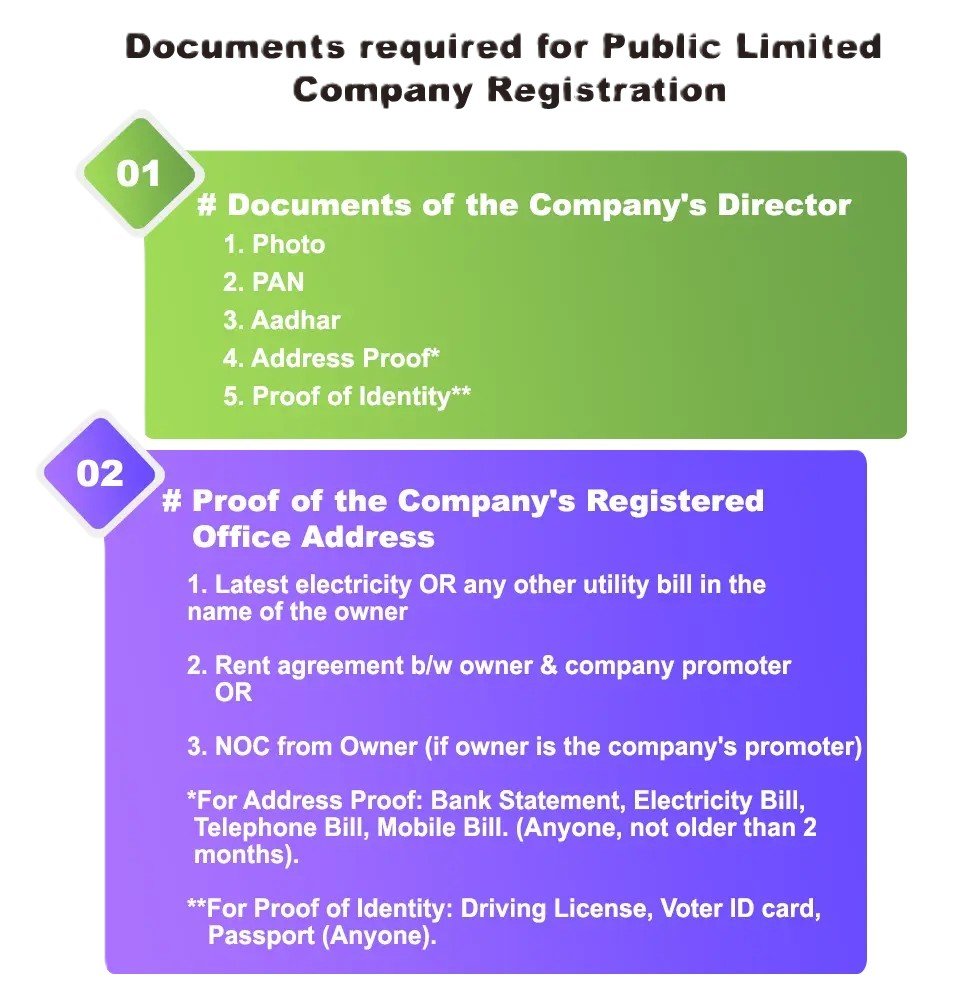
Documents required for Public Limited Company Registration
For company registrations, documents requirements are simple and handy. You must have the following documents under
# Documents of the Company’s Director
1. Photo
2. PAN
3. Aadhar
4. Address Proof*
5. Proof of Identity**
# Proof of the Company’s Registered Office Address
1. Latest electricity OR any other utility bill in the name of the owner
2. Rent agreement b/w owner & company promoter
OR
3. NOC from Owner (if owner is the company’s promoter)
*For Address Proof: Bank Statement, Electricity Bill, Telephone Bill, Mobile Bill. (Anyone, not older than 2 months).
**For Proof of Identity: Driving License, Voter ID card, Passport (Anyone).
Talk to Advisors
Difference between Public limited Company and Private Limited Company
| S.No | Private Limited Company | Public Limited Company |
|---|---|---|
| 1 | Shares here can not be traded on the stock exchange. | Public Limited Companys shares can be exchanged on the stock market. |
| 2 | Maximum number of shareholders can be 200. | no limit to the number of shareholders |
| 3 | Private Limited Company Registration requires a minimum of two shareholders. | Public Limited Company Registration requires a minimum of seven shareholders. |
| 4 | Fewer Legal Requirements. | More Legal Requirements. |
| 5 | A minimum share capital of Rs. 1 Lakh is required. | A minimum share capital of Rs. 5 lakh is required. |
Contact us
Highlights
#1. Limited Liability
Liability of shareholder for the losses of the company is limited to their contribution only.
#2. Perpetual Succession
A business of the Company will not affect if there is any change in the ownership of the company.
#3. Listing on Stock Exchange
Public Company can be listed on stock exchange and raise funds by way of public issue.
#4. Transferable Shares
Shares of a public company are freely transferable between its members and non-members.
#5. Disclosure & Transparency
The public company ensures stringent disclosure compliances. Financials of the company is in public domain.
#6. Minimum Directors & Shareholders
Minimum 3 directors, Minimum 7 shareholders required and there is no limit on maximum shareholders of the company.
Why choose public limited company
Upload the Required Documents & Information to our web portal
#1. Unlimited Members
One of the best advantage of public ltd company is that there is no limit on number of members in the company.
#2. Limited Liability
Despite having characteristic of unlimited members the liability of all the directors in Public limited company is limited to the extent of stake they hold in the company.
#3. More Transparency
Working of a public ltd company is more transparent because it separates its management from its ownership.
#4. Property Rights
A Public ltd Company can gain, posses, and enjoy its property in its own name. No shareholder can claim upon the property
Public limited company incorporation process
STEP 1
Upload the Required Documents & Information to our web portal
STEP 2
Choose Package and Pay online with different payments modes available
STEP 3
We will apply for Digital Signature and Director Identification Number of proposed directors
STEP 4
Check for Company’s Name availability, apply for Name Approval.
STEP 5
Prepare MOA, AOA and other necessary incorporation documents.
STEP 6
File incorporation documents & obtain Certificate of Incorporation, PAN &TAN.
Advantages of Public Limited Company Registration in India
#1. Raising funds is easy as Public Limited Company can issue the shares to the public. Thus, expansion and growth is rapid
#2. Death or departure of its shareholders or directors does not dissolve the company. Thus, business continuity is possible.
#3. Better corporate governance and accountability are promoted as Public Limited Companies are subjected to strict regulations and guidelines.
#4. The shares of a Public Limited Company can be easily sold or bought on the stock exchange, offering shareholders greater transferability and liquidity of their investment.
#5. Public Limited Companies can enjoy various tax benefits which are beneficial for both the company and its shareholders.
Annual Compliances for a Public Limited Company
Listed and Unlisted Public Limited Companies have to follow a set of annual compliances in order to function legally. These are as follows:
Annual Compliances for Listed Public Limited Company
| No. | Compliance | Details | Form | Section | Deadline |
|---|---|---|---|---|---|
| 1 | Annual General Meeting | Conduct AGM in compliance with the Companies Act | Form MGT-15 | Section 121(1) of the Companies Act, 2013 | Within 30 days from the date of incorporation |
| 2 | Financial Statements | Prepare and file financial statements, including balance sheet, directors report, cash flow statement, auditors report and consolidated financial statement in XBRL format | Form AOC-4 | Section 137 of the Companies Act read with Rule 12(2) of the Companies (Accounts) Rules, 2014 | Within 30 days of holding the AGM |
| 3 | Annual Return | File information about directors and shareholders with the Registrar of Companies | Form MGT-7 | Section 92 of the Companies Act, 2013 read with Rule 11(1) of the Companies (Management and Administration) Rules 2014 | Within 60 days of the AGM |
| 4 | Financial and Directors Report | Adopt financial and directors reports | Form MGT-14 | Section 173 read along with Secretarial Standards 1 | Within 30 days from the board meeting |
| 5 | Income Tax Returns | File income tax returns with the Tax Department | Form ITR-6 | — | On or before September 30th of the financial year |
| 6 | Secretarial Audit Repor | Submit Secretarial Audit Report along with Board Report if total paid-up capital is equal to or crosses Rs. 50 crore or annual turnover exceeds Rs. 250 crore | Form MR-3 | Section 204 of Companies Act, 2013 read with Rule 9 of The Companies (Appointment and Remuneration Personnel) Rules, 2014 | Before appointment or reappointment of The Secretarial Auditors |
| 7 | SEBI Compliance | Comply with all rules and regulations associated with SEBI, including Listing Regulations of 2015 | — | Listing Regulations of 2015, SEBI | — |
Annual Compliances for Unlisted Public Limited Company
| S.No | Compliance | Particulars of Compliance | Form No. | Section and Rules | Due Dates |
|---|---|---|---|---|---|
| 1 | Board Meeting | Conduct at least four meetings a year and discuss matters related to the appointment or reappointment of auditors or related issues. | N/A | Section 173 of the Companies Act | At least 4 Board meeting in a year. |
| 2 | Appointment of Cost Auditor | Issue a letter of appointment to the Cost Auditor and inform the Central government of its appointment. | Form CRA-2 | Section 148(3) along with Rule 6(2) and Rule 6(3A) of the Companies (Cost Records and Audit) Rules,2014 | Original appointment within 30 days of the Board Meeting or 180 days of the financial year, whichever is earlier. Casual vacancy to be filled within 30 days of Board Meeting. |
| 3 | Return of Deposits (DPT) | File the Return of Deposit before the Registrar of Companies or ROC. | Form DPT-3 | Rule 16 of Companies (Acceptance or Deposit) Rules, 2014 | 30th June of every year. |
| 4 | Appointment of CEO or CFO or CS | Appoint a full-time or casual CEO or CS or CFO and file the necessary forms. | Form MGT- 14 and Form DIR-12 | Section 203 read with Rule 8 and 8A of the Companies (Appointment and Remuneration of Managerial Personnel) Rules, 2014 | Within 30 days of the Annual General Meeting and, in the case of a casual vacancy, within 6 months. |
| 5 | Annual General Meeting | Conduct the Annual General Meeting for the declaration of dividends. | N/A | Section 96 of the Companies Act, 2013 | First Annual General Meeting to be held within 9 months of the end of the financial year. |
| 6 | Special Resolution | File the Special Resolution passed at the Annual General Meeting. | N/A | Section 117 of the Companies Act, 2013 to be read with Rule 24 of the Companies (Management and Administration) Rules, 2014 | Within 30 days of passing the resolution. |
| 7 | CSR Committee | Hold meetings and approve CSR activities. | N/A | Section 135 of the Companies Act, 2013 read with Companies (Corporate Social Responsibility Policy) Rules, 2014 and SS-1 | Hold at least four Board meetings with a gap of not less than 120 days between two Board meetings. |
| 8 | Director’s Disclosure | Directors must disclose their financial interests in the company. | Form MBP-1 | Section 184(1) of the Companies Act, 2013 to be read along with Rule 9(1) of the Companies (Meetings of Board and its Powers) Rules,2014 | After their appointment in the first meeting. |
Documents required for Public Limited Company Registration
For company registrations, documents requirements are simple and handy. You must have the following documents under
# Documents of the Company’s Director
1. Photo
2. PAN
3. Aadhar
4. Address Proof*
5. Proof of Identity**
# Proof of the Company’s Registered Office Address
1. Latest electricity OR any other utility bill in the name of the owner
2. Rent agreement b/w owner & company promoter
OR
3. NOC from Owner (if owner is the company’s promoter)
*For Address Proof: Bank Statement, Electricity Bill, Telephone Bill, Mobile Bill. (Anyone, not older than 2 months).
**For Proof of Identity: Driving License, Voter ID card, Passport (Anyone).
Difference between Public limited Company and Private Limited Company
| S.No | Private Limited Company | Public Limited Company |
|---|---|---|
| 1 | Shares here can not be traded on the stock exchange. | Public Limited Companys shares can be exchanged on the stock market. |
| 2 | Maximum number of shareholders can be 200. | no limit to the number of shareholders |
| 3 | Private Limited Company Registration requires a minimum of two shareholders. | Public Limited Company Registration requires a minimum of seven shareholders. |
| 4 | Fewer Legal Requirements. | More Legal Requirements. |
| 5 | A minimum share capital of Rs. 1 Lakh is required. | A minimum share capital of Rs. 5 lakh is required. |
Types of Company Registration
- COMPARISON
- Regulate by Act
- Equity Funding
- Taxation
- Number of Shareholders
- Separate Legal Entity
- Limited Liability
- Statutory Audit
- Statutory Compliances
- Foreign Participation / Investment
- Recommended for
- PRIVATE LIMITED COMPANY
- Companies Act 2013
- Easily Possible
- 26%
- Minimum 2 Maximum 200
- Yes
- Yes
- Mandatory
- Moderate
- Allowed
- Startups
- ONE PERSON COMPANY
- Companies Act 2013
- Not Possible
- 26%
- Only one
- Yes
- Yes
- Mandatory
- Moderate
- Not Allowed
- Sole Proprietor
- LIMITED LIABILITY PARTNERSHIP
- Limited Liability Act, 2008
- Possible, but unlikely
- 31.2%
- Minimum 2 Maximum – Unlimited
- Yes
- Yes
- If turnover exceed Rs.40 Lakhs
- Less
- Allowed
- Professionals [CA, Architect, Agencies, Consultant, etc]
Packages
Basic
₹28999
Plus taxes
Certificate of Incorporation
Current Bank Account*
MOA & AOA
3 DIN, PAN & TAN
(3 Indian Directors, 7 Shareholders and Authorised Capital of Rs. 5,00,000)
Standard
₹30499
Plus taxes
Certificate of Incorporation
Current Bank Account*
MOA & AOA
3 DIN, PAN, TAN,
GST Registration
(3 Indian Directors, 7 Shareholders and Authorised Capital of Rs. 5,00,000)
Premium
₹34499
Plus taxes
Certificate of Incorporation
Current Bank Account*
MOA & AOA
3 DIN, PAN, TAN,
GST Registration
GST Invoice Software for 1-year validity
Website**
(3 Indian Directors, 7 Shareholders and Authorised Capital of Rs. 5,00,000)
frequently asked questions
When it is required to form a Public Ltd Company?
When you need funding directly from public or want public to invest in your business or if you are planning to bring IPO of your company
How many people are required to incorporate a public limited company?
Minimum 7 members are required to incorporate a public limited company. There is no bar at the maximum number of members in a public limited company.
Who can be a director of a company?
Any person who attends the age of 18 can be director of the company
Is there any address proof required/mandatory for public ltd company?
Yes to incorporate your company latest utility bill along with NOC from property owner in favor of company is required
How many shareholders can be there in a public limited company?
Minimum 3 shareholders are required to incorporate a public limited company and There is no limit on a maximum number of shareholders.
How many directors can be there in public ltd company?
Minimum 3 Maximum 15 directors can manage the show of a company
What is a DSC?
DSC stands for Digital Signature Certificate. It is basically a pen drive containing your signature in a digital form and is password protected.It is mandatorily required to sign the various incorporation applications by directors and shareholders digitally. It is only issued by government authorized agencies.
What are MOA and AOA?
MOA and AOA are charter documents of the company. It defines the business objectives and rules & regulations of the company. It is drafted by our professionals and delivers to you along with Certificate of incorporation
Will you provide this service in my town?
Yes E-Startup is an online platform serving all over India no matters wherever you are doing business all you need is internet connection on your mobile or desktop and we are ready to get your job done.
Not found answer to your question! Arrange a call back
Contact us
For any Enquiry +91-000000000
Why Choose Us

Serving business owners with an Average 4.8+ Google Rating.

Trusted by Axis bank to cater its clients all licensing & compliance needs.

Providing lending solutions for business needs with NeoGrowth.

Open Neo bank account worldwide & provides cross-border remittance solutions.

E-startup is a Proudly Member of Confederation of Indian Industry.The CII is a premier business association in India which works to create an environment.

bharat Digi is duly certified under GOI’s Startup scheme and is renowned for our tech-driven solutions for business & legal services requirements for MSMEs.

Bharat Digi is a Google Partner, which implies we are rigorously involved in assisting SME businesses to market their presence in the digital world.
Popular Services
Private Limited Company | Public Limited Company | One Person Company | Limited Liability Partnership | Partnership Firm | Sole Proprietorship Firm | Section 8 Company Registration | USA Company Registration | UK Company Registration | UAE Company Registration | Singapore Company Registration | Company Registration Hong Kong | Import Export Code | IEC Modification | AD Code Registration | Spice Board Registration | US FDA Certification | ISO 9001 2015 | ISO 14001 EMS | ISO 22000 FSMS | ISO 27001 ISMS | ISO 50001 Energy Management | ISO 45001 | ISO Surveillance | ISO Certification | MSME Registration | FSSAI Registration | Shop Establishment Registration | Barcode Registration | Coffee Board Registration | Startup India Certificate | ZED Certification | Trademark | Trademark Objection Reply | Trademark Opposition | Trademark Hearing | Trademark Formality Check Fail | Website Development | Patent | Copyright | Design Registration | Business Name Suggestion | Logo Designing | Trademark Assignment Service | GST Registration | GST Modification | GST Cancellation | GST Return Filing | GST Invoice Software | UIN Registration | Income Tax Return | Income Tax Notice | Income Tax Refund | Income Tax Assessment | TDS Return Filing | Form 15CA / CB | Professional Tax Registration | 12A and 80G Registration | FCRA Registration | CSR Registration | Project Report | Pitch Deck | Seed Fund Startup India | Accounting for Ecommerce | Virtual cfo services in india | Bookkeeping & Accounting | Private limited Company Annual Compliance | Form INC-22A | Form 15CA / CB | Company Strike Off | Commencement of Business | Fssai annual return | Online CA Consultancy | Income Tax Return Filling | LLP Annual Compliances | Form DIR-3 KYC | Virtual Office for Company Registration | Dubai Company Registration | Business registration for USA | Business registration for UAE |